
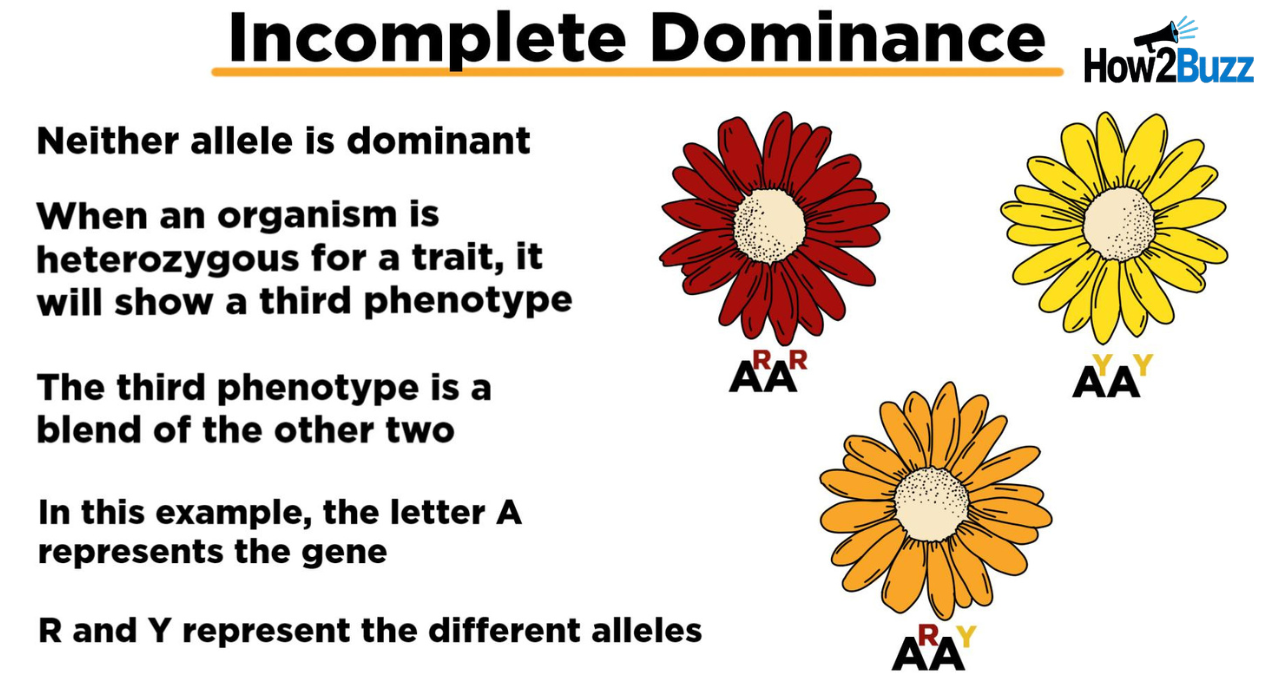

When people start Incomplete Dominance Example, they often get stuck at understanding how traits actually show up in offspring. Most of us have heard of Mendel’s experiments with peas, where traits are either dominant or recessive. But what if neither gene takes complete control? That’s where the incomplete dominance example comes into play. It’s one of those fascinating exceptions that shows us how genetics is more colorful, quite literally, than just black and white.
To break it down, incomplete dominance happens when neither allele (the versions of a gene) is fully dominant over the other. Instead of one trait masking the other, the offspring display a blended or intermediate trait. It’s like mixing paints rather than flipping a light switch on or off. Once you see how it works, especially with easy illustrations from plants, animals, and even humans, you’ll understand why biology teachers love using it in classrooms.
Understanding Incomplete Dominance Example in Simple Terms
The best way to grasp the incomplete dominance example is to start with plants. Imagine a red flower and a white flower crossing together. If genetics were purely dominant and recessive, you would expect the offspring to be either all red or all white, depending on the dominant gene. But in incomplete dominance, that’s not what happens. Instead, the offspring turn out pink — a perfect mix of both parent traits. Neither color fully takes over, so the result is a new shade.
This isn’t just a quirky exception. It actually proves that inheritance isn’t always straightforward. Scientists use this concept to explain how traits in living things can combine in unique ways. Think of it as nature’s version of a collaboration, where each parent’s genetic input contributes equally, without overpowering the other. This gives us variations that are more diverse, which helps species adapt and thrive.
Incomplete Dominance Example in Human Genetics
One of the most relatable places where we can see an incomplete dominance example is in human genetics. Take hair texture, for instance. If one parent has curly hair and the other has straight hair, their child might not inherit one or the other. Instead, the child’s hair could be wavy — sitting perfectly in between. This is a classic incomplete dominance scenario.
Skin tone can also illustrate this idea. A child born to parents with different skin colors often has a complexion that is intermediate between the two. While many factors influence skin tone, this blending effect shows how genes can create diversity in ways that pure dominance cannot explain. It’s not about one parent’s genes overshadowing the other, but rather about a new expression forming that reflects both.
How an Incomplete Dominance Example Differs from Codominance
It’s easy to confuse incomplete dominance with codominance, but they’re not the same thing. In an incomplete dominance example, the traits mix together, creating something new. With codominance, however, both traits appear side by side without blending. For example, if you cross a white flower with a red one in codominance, you might get petals that are both red and white, not pink.
This distinction is important for understanding genetics correctly. Teachers often emphasize this because students tend to mix up the two. By keeping the pink flower scenario in mind for incomplete dominance, and the spotted or striped versions for codominance, the difference becomes clearer. Each has its place in explaining the variety of traits we see in nature.
Real-Life Incomplete Dominance Example in Plants
Plants give us some of the best and most visible illustrations of incomplete dominance. The most famous case is the snapdragon flower. A red snapdragon crossed with a white snapdragon often produces pink offspring. Similarly, in four o’clock plants, the blending of flower colors follows the same principle. These examples make genetics more visual and easier to understand, especially for beginners.
It’s fascinating to see how this kind of inheritance adds to biodiversity. Instead of limiting plants to just one trait or the other, incomplete dominance allows for a broader palette of colors. This doesn’t just make gardens prettier — it also plays a role in survival, since diverse traits may adapt better to different environments. Nature, after all, thrives on variation.
Animal Traits as an Incomplete Dominance Example
The animal world also offers plenty of examples. For instance, in some breeds of chickens, crossing a black-feathered bird with a white-feathered one can produce offspring with bluish-gray feathers. This intermediate shade is a perfect incomplete dominance example. It’s not black, it’s not white, but a blend that showcases both genetic contributions.
Another interesting case can be seen in some cattle and horse breeds. When certain coat colors mix, the result is often a diluted or blended version of the parent traits. This demonstrates how incomplete dominance shapes traits beyond flowers and humans, making it a universal concept in biology.
Why Incomplete Dominance Example Matters in Biology
The reason scientists focus so much on the incomplete dominance example is because it challenges the oversimplified view of genetics. If traits were always strictly dominant or recessive, the world would look a lot less diverse. By showing us how blending works, incomplete dominance highlights the complexity of inheritance and the creative ways genes can express themselves.
This concept also helps researchers understand genetic disorders and variations. By studying how traits blend rather than dominate, scientists can make better predictions about offspring characteristics. It opens the door to understanding everything from physical traits to potential health risks.
The Role of Incomplete Dominance Example in Evolution
Evolution thrives on genetic variation, and incomplete dominance is one of the mechanisms that support it. When traits blend, populations gain new characteristics that may offer survival advantages. For example, an intermediate trait may be more adaptable to environmental changes than either extreme. That’s why the incomplete dominance example is more than just a classroom topic — it’s an evolutionary tool.
In addition, this blending effect helps maintain genetic diversity within populations. Instead of traits being lost due to dominance, incomplete dominance keeps multiple gene expressions alive in the gene pool. This ensures that species don’t lose out on potentially beneficial traits over time.
Practical Uses of Studying Incomplete Dominance Example
Beyond understanding inheritance, the incomplete dominance example has practical uses in agriculture, animal breeding, and even medicine. Plant breeders often use this principle to create new flower colors or crop varieties that are more appealing to consumers. By harnessing incomplete dominance, they can develop plants with intermediate traits that meet specific needs.
In the medical field, studying incomplete dominance can provide insights into how certain traits or conditions manifest in humans. It’s not always about diseases; sometimes it’s about understanding how genetic variations influence everyday characteristics like hair type or skin tone. This knowledge can improve genetic counseling and family planning.
Conclusion
The incomplete dominance example might look like a small detail in genetics, but it has huge implications. It shows us that inheritance isn’t just about one trait overpowering another. Instead, traits can blend in creative and unexpected ways, leading to the rich diversity we see in nature. Whether it’s pink flowers, wavy hair, or bluish-gray feathers, incomplete dominance proves that genetics is more like mixing paint than following rigid rules.