
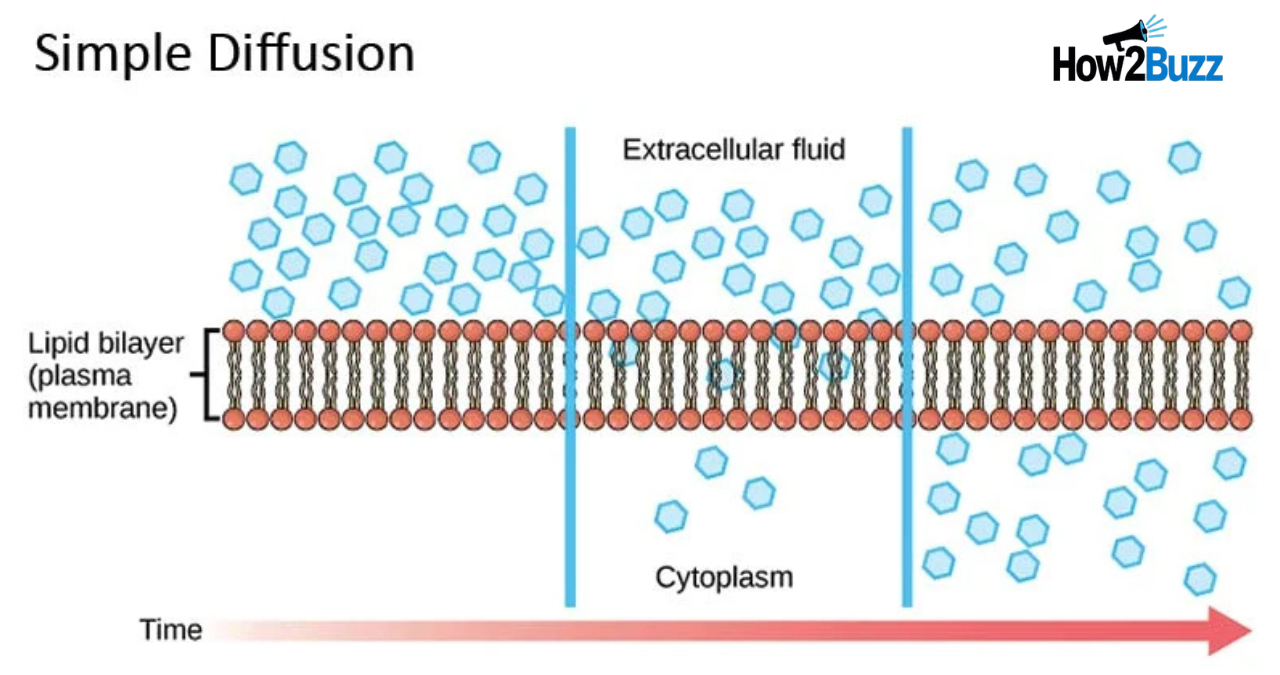

When people first hear the term simple diffusion, it often sounds like something complex out of a science textbook. But the truth is, this natural process is one of the most basic and essential principles that keeps living organisms functioning. Whether you’re a biology student, a health enthusiast, or just curious about how life works at a cellular level, understanding this process will give you a whole new appreciation of how bodies maintain balance.
At its core, simple diffusion is about movement—particles naturally spreading out from areas where they are more crowded to where they are less crowded. This effortless motion requires no energy from the cell, making it an incredibly efficient mechanism. Think of it like pouring a drop of food coloring into water and watching it spread without stirring—the particles just move on their own.
What is Simple Diffusion?
In the simplest terms, simple diffusion is a type of passive transport. Passive transport means that cells don’t have to spend any energy to make it happen. Instead, molecules such as oxygen, carbon dioxide, and even small lipid-soluble substances glide directly across the cell membrane. This movement continues until the concentration of molecules is equal on both sides, creating a state known as equilibrium.
What makes this process so fascinating is that it happens everywhere and all the time. Every breath you take relies on simple diffusion for oxygen to move into your bloodstream and for carbon dioxide to leave. Without it, your body would struggle to maintain the balance needed to survive. It’s one of those silent, invisible processes that we rarely think about, yet it literally keeps us alive.
How Simple Diffusion Works in Cells
To understand how simple diffusion actually occurs, imagine the cell membrane as a flexible gate. This gate doesn’t need to open and close with effort; instead, it allows certain molecules to pass freely depending on their size and solubility. Smaller molecules like oxygen and carbon dioxide can slip right through, while larger or charged particles often require different transport systems.
What’s beautiful about this system is its efficiency. Instead of needing pumps or carriers, molecules move purely due to differences in concentration. Nature essentially does the work for the cell, ensuring that essential molecules are distributed evenly. This makes simple diffusion a cornerstone of biology, not just an interesting side note in textbooks.
Why Simple Diffusion Matters in Daily Life
Though it sounds highly technical, simple diffusion isn’t just a scientific concept—it has direct implications in everyday life. Take breathing, for example. When you inhale, oxygen concentration in the lungs is high, while in the blood it is lower. Through diffusion, oxygen naturally flows into your bloodstream without you doing anything consciously. The same process helps remove carbon dioxide every time you exhale.
Another example is how nutrients and waste products move between blood and tissues. The balance maintained by simple diffusion ensures that cells get what they need while removing what they don’t. Without it, basic survival processes like breathing, eating, and even cellular communication would be disrupted.
Differences Between Simple and Facilitated Diffusion
It’s easy to confuse simple diffusion with facilitated diffusion, but there are key differences. In simple diffusion, molecules move directly across the lipid bilayer without assistance. Facilitated diffusion, however, involves helper proteins that guide molecules across the membrane. Both are passive processes, but facilitated diffusion is more specialized.
Understanding these differences isn’t just about passing an exam. It highlights how cells have evolved to balance efficiency with selectivity. While simple diffusion works for small, nonpolar molecules, facilitated diffusion ensures larger or polar molecules get through in a controlled manner. Together, they create a system of checks and balances that keeps the cell environment stable.
Examples of Simple Diffusion in Nature
One of the most striking examples of simple diffusion happens in the lungs. The exchange of oxygen and carbon dioxide across the alveolar membrane is a textbook case of this process. Oxygen moves from the air sacs into the blood because of its higher concentration in the lungs, while carbon dioxide moves in the opposite direction.
Another example can be found in aquatic environments. Fish, for instance, rely on diffusion across gill membranes to absorb oxygen from water. Plants also use simple diffusion to exchange gases like oxygen and carbon dioxide through tiny pores called stomata. These examples show how universal this process is, bridging species and ecosystems.
Factors That Influence Simple Diffusion
Although simple diffusion is effortless, it’s not always the same speed or efficiency. Several factors influence how fast molecules spread. Temperature is one major factor—the warmer the environment, the faster the molecules move. This explains why diffusion is quicker in heated solutions compared to colder ones.
Another factor is the concentration gradient. The steeper the gradient—the difference between high and low concentration—the faster the movement. Similarly, the size of the molecules plays a role. Smaller molecules like oxygen diffuse much more quickly than larger molecules. Even the thickness of the membrane can affect how smoothly diffusion occurs.
Advantages of Simple Diffusion
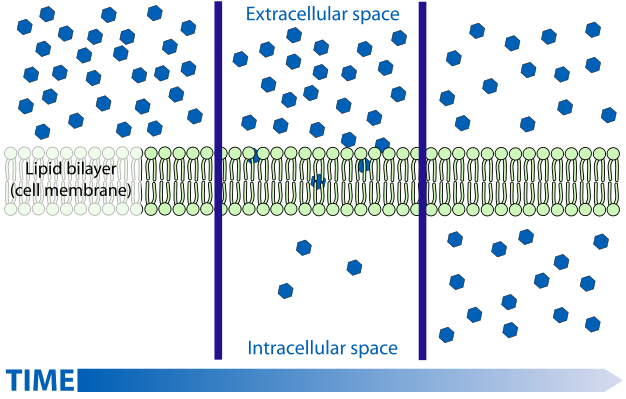
One of the biggest advantages of simple diffusion is that it doesn’t require energy. Cells save a tremendous amount of resources by allowing certain molecules to passively move across membranes. This efficiency allows energy to be spent on more demanding processes, like active transport or cellular repair.
Another advantage is reliability. Because diffusion follows natural laws of movement, it doesn’t depend on complicated cellular machinery. This consistency ensures that oxygen and carbon dioxide exchange, for example, always happens when needed. Without the stability provided by simple diffusion, organisms would struggle to maintain balance.
Limitations of Simple Diffusion
As powerful as it is, simple diffusion isn’t perfect. One limitation is that it only works efficiently over short distances. This is why larger organisms need specialized systems, like circulatory systems, to move molecules quickly across their bodies. If diffusion alone were responsible, it would take far too long for oxygen to reach every cell.
Another limitation is selectivity. Only small, nonpolar molecules can pass freely across membranes. Larger molecules or charged ions require more complex transport mechanisms. This is where processes like facilitated diffusion or active transport become essential, complementing what simple diffusion cannot achieve.
Conclusion
Simple diffusion may seem like a small detail in the grand scheme of biology, but it’s actually one of the most fundamental processes that life depends on. By allowing molecules to move naturally across membranes, it keeps cells balanced, efficient, and alive. From every breath you take to the way plants exchange gases, diffusion is always at work.